
Bangalore Real Estate Investment continues to draw homebuyers, NRIs, and long-term investors from across India — but with prices shifting and new corridors opening up, the question every buyer is asking in 2026 is simple: is now the right time to invest? This guide breaks down the data, the best-performing localities, and the mistakes to avoid, with insights from Vestawisse’s property investment specialists.
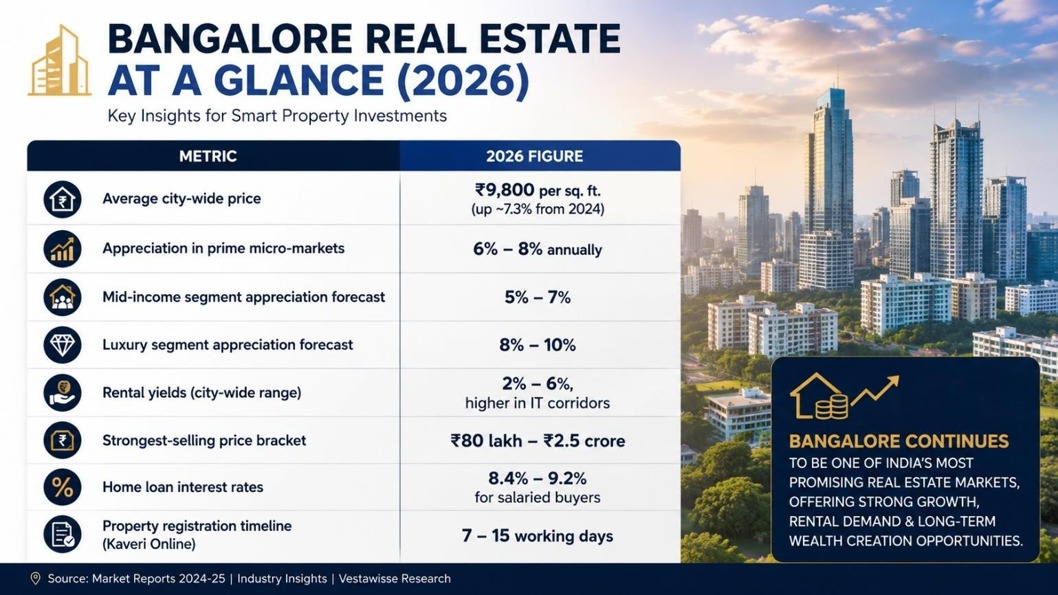

Bangalore Real Estate Investment has consistently outperformed most Indian metros over the past decade, and the reasons go far beyond hype. The city sits at the center of India’s technology economy, hosting a dense concentration of IT/ITES companies and Global Capability Centres (GCCs) that generate steady, high-paying employment. This employment engine is the single biggest structural driver of housing demand in the city.
Add to this a cosmopolitan population base, strong educational and healthcare infrastructure, and a genuinely international lifestyle, and it becomes clear why Bangalore remains the preferred entry point for NRIs looking to invest back home. Unlike speculative markets driven by short bursts of buying, Bangalore’s growth has largely tracked genuine economic expansion — office space absorption, job creation, and infrastructure investment — which is what gives long-term investors confidence.

The Bangalore property market 2026 is best described as a market in healthy consolidation rather than a boom or a slowdown. After a sharp price run-up between 2023 and 2025 — fuelled by post-pandemic demand, rising construction costs, and a wave of premium launches — the market is now moving into a more disciplined phase: measured new supply, more selective buyers, and price growth that rewards genuine value over hype.
City-wide, average prices sit around ₹9,800 per square foot, but this masks enormous variation. Established, land-constrained neighbourhoods such as Indiranagar, Koramangala, and HSR Layout command ₹12,000 to over ₹20,000 per square foot, while emerging corridors like Hoskote and Doddaballapur remain accessible at ₹5,000 to ₹8,000 per square foot. New launches in growth corridors such as Sarjapur Road and North Bangalore typically fall between ₹8,500 and ₹11,000 per square foot.
Two data points matter most for investors right now. First, the ₹80 lakh to ₹2.5 crore segment shows the strongest transaction absorption in the city — this is where genuine end-user and investor demand is concentrated. Second, while unsold inventory rose roughly 24% year-on-year in Q1 2026, transaction volumes grew alongside it, which signals a market where supply is catching up to demand rather than demand collapsing.
Industry data indicates that a sharp correction in 2026 is unlikely. Instead, expect price stability and slower, healthier growth as developers moderate new launches and buyers become more selective — a dynamic that tends to favour well-researched investors over speculative ones.

For most long-term buyers, yes — with the right approach. As price momentum cools from the rapid 2023-2025 run-up, buyers currently have more negotiating leverage, wider inventory choice, and access to more attractive payment plans than they did eighteen months ago. At the same time, the underlying demand fundamentals — IT/GCC hiring, infrastructure expansion, and steady in-migration remain intact, which supports continued appreciation over a multi-year holding period.
The caveat: 2026 rewards research-driven decisions, not impulse purchases. Investors who study locality-level infrastructure timelines, rental demand patterns, and builder track records before buying are positioned to benefit from this phase. Those chasing short-term speculative gains may find the market less forgiving than it was during the previous upcycle.

Location remains the single biggest driver of returns in Bangalore Real Estate Investment. Below are the corridors experts consistently point to in 2026, each suited to a slightly different investment goal.
Locality | Approx. Price/sq.ft. | Rental Yield | Best Suited For |
Whitefield | ₹8,500 – ₹11,000 | 3.5% – 4.5% | IT-corridor rental income, metro connectivity |
Sarjapur Road | ₹8,000 – ₹10,500 | 3.5% – 4% | Rapid appreciation, ORR employment access |
HSR Layout | ₹12,000 – ₹16,000 | 3% – 4% | Limited supply, premium end-user demand |
North Bangalore / Devanahalli | ₹6,500 – ₹9,500 | 3% – 4% | Airport-linked growth, long-term appreciation |
Electronic City | ₹6,000 – ₹8,500 | 4% – 5% | Higher rental yield, tenant-heavy micro-market |
Kanakapura Road | ₹5,500 – ₹8,000 | 4% – 5% | Affordability with improving connectivity |
Koramangala / Indiranagar | ₹12,000 – ₹20,000+ | 2% – 3% | Capital stability, premium/luxury positioning |
As a rule of thumb: choose Electronic City, Kanakapura Road, or Whitefield if rental yield is your priority; choose HSR Layout, Koramangala, or Indiranagar if capital preservation and long-term stability matter more than yield; and choose Sarjapur Road or North Bangalore/Devanahalli if you want early entry into the city’s next high-growth corridors.

Both residential and commercial real estate have a place in a Bangalore investment portfolio, but they suit different risk appetites, budgets, and involvement levels.
Factor | Residential | Commercial |
Typical entry capital | Lower (₹50L – ₹2.5Cr common) | Higher (₹1.5Cr and above typical) |
Rental yield | 2% – 5% | 6% – 9% |
Appreciation potential | Steady, broad-based | Strong in prime business districts |
Liquidity / resale ease | Higher, larger buyer pool | Lower, niche buyer pool |
Management involvement | Low to moderate | Higher (lease structuring, compliance) |
Ideal investor | First-time buyers, end-users, NRIs | Experienced investors, HNIs |
For most first-time investors, residential property in established or emerging IT corridors offers the best balance of affordability, liquidity, and manageable risk. Commercial real estate — office space, retail units, or co-working assets — can deliver stronger cash yields but requires more capital, longer-term commitment, and closer management.
Understanding the Home Loan Down Payment requirements in Bangalore before beginning your property search allows you to plan your finances more effectively. Along with comparing home loan options in Bangalore, buyers should also evaluate their housing loan eligibility in Bangalore, understand the bank loan process in Bangalore, and estimate the total cost of purchasing a property.
A well-planned budget not only improves financial confidence but also helps buyers shortlist properties that truly fit their affordability. Before making a final decision, buyers can explore suitable residential projects through Vestawisse New Projects and seek personalized guidance through the Vestawisse Consultant to make informed property investment decisions

Return on property in Bangalore typically comes from two combined sources: capital appreciation and rental income. Current forecasts suggest mid-income residential segments can expect 5% to 7% annual appreciation, while luxury properties may see 8% to 10%, supported by strong demand from affluent buyers and NRIs. Rental yields vary significantly by corridor — tenant-heavy IT micro-markets like Electronic City and Kanakapura Road post 4% to 5% yields, while premium, low-supply areas like Koramangala post lower yields of 2% to 3% but stronger capital stability.
When evaluating ROI, investors should look at total return (appreciation plus rental yield) over a realistic holding period of five years or more, rather than expecting quick flips. Financing costs also matter: with home loan rates currently between 8.4% and 9.2%, factoring in interest costs is essential to an accurate ROI calculation.
Note: The figures above are general market indicators, not guaranteed returns. Property investment carries market risk, and individual outcomes depend on location, project quality, and holding period. This article is for informational purposes and should not be treated as financial or legal advice — consult a licensed financial advisor and legal counsel before making an investment decision.

Navigating Bangalore’s real estate market — with its dozens of micro-markets, varying price bands, and shifting regulatory requirements — is far easier with an experienced, locally grounded partner.
Vestawisse Consultant works exclusively on helping homebuyers, investors, and NRIs make informed, well-researched property decisions across Bangalore’s top-performing corridors.
Whether you are buying your first home, building a rental income portfolio, or investing as an NRI, Vestawisse’s local expertise helps you avoid costly mistakes and identify the corridors best aligned with your goals.
Yes. While price growth has moderated after the sharp 2023–2025 run-up, fundamentals like IT-sector hiring, infrastructure expansion, and steady migration remain strong, making 2026 a favourable window for well-researched, long-term buyers.
Electronic City, Kanakapura Road, and Whitefield currently offer some of the strongest rental yields, typically between 3.5% and 5%, driven by high tenant demand from nearby IT employment hubs.
City-wide averages sit around ₹9,800 per square foot. Emerging areas like Hoskote and Doddaballapur range from ₹5,000 to ₹8,000, while established neighbourhoods like Indiranagar and Koramangala exceed ₹12,000 to ₹20,000 per square foot.
Residential property suits most first-time investors due to lower entry capital and easier resale, while commercial property offers higher rental yields (6–9%) but requires more capital and active management.
A sharp decline is unlikely. Experts expect price stability and slower, healthier growth as developers moderate supply and buyers become more selective, rather than a market crash.
Through the Kaveri Online system, registration typically takes 7 to 15 working days once documentation, encumbrance certificate verification, and stamp duty payment are complete.
Yes. Bangalore’s cosmopolitan lifestyle, strong rental demand, transparent RERA-backed transactions, and consistent appreciation make it one of the most preferred Indian cities for NRI property investment.
Bangalore Real Estate Investment in 2026 rewards patience, research, and local expertise over speculation. With price momentum cooling, fundamentals intact, and infrastructure projects steadily unlocking new growth corridors, this is a market that favours buyers who do their homework — whether the goal is a family home, a rental-yield asset, or a long-term wealth-building investment.
The right locality, the right project, and the right timing all matter — and getting expert, unbiased guidance can be the difference between an average investment and an exceptional one.
WhatsApp us